Jean-François Lafont
Other Information:
I joined OSU as a postdoc in 2005, to work with
Mike Davis, and ended up staying here.
And here's a pretty hilarious music video (which
I got from my youngest brother... hmmm... wonder why he forwarded it to me?)
Editorial Work:
I am a member of the Editorial Board for the London Mathematical Society Student Texts book series.
Editor for the proceedings for the ICM satellite conference "Geometry, topology and dynamics in negative curvature".
Published by the London Mathematical Society, Lecture Notes series, Vol. 425.
Editor for the proceedings for the OSU special year "Topology and geometric group theory". Published by Springer-Verlag, Proceedings in Mathematics series, Vol.
184.
Editor for the proceedings for the conference "Topological methods in group theory", held in honor of Ross Geoghegan. Published by the London Mathematical Society, Lecture Notes series, Vol. 451.
Former Students:
Raeyong Kim (2012) - On the theorem of Kan-Thurston and algebraic rank of CAT(0) groups. (Co-advised by
Ian Leary)
Kyle Joecken (2013) - Dimension of classifying
spaces for virtually cyclic subgroups of certain geometric groups.
Ryan Kowalick (2013) - Discrete systolic inequalities.
Kun Wang (2014) - On the Farrell-Jones conjecture.
Andy Nicol (2014) - Quasi-isometries of graph manifolds do
not preserve non-positive curvature.
Shi Wang (2016) - Barycentric straightening, splitting rank and bounded cohomology.
Bakul Sathaye (2018) - Obstructions to Riemannian smoothings of locally CAT(0) manifolds.
Josiah Oh (2022) - Quasi-isometric rigidity of a product of lattices, and the coarse geometry of non-transitive graphs.
Gustavo Chaparro Sumalave (2023) - Topological rigidity of hyperbolic manifolds with piecewise totally geodesic boundary.
Current Students:
Postdoctoral advising (former, current, and future):
RESEARCH INTERESTS:
My research focuses on the interplay between geometry, topology, and
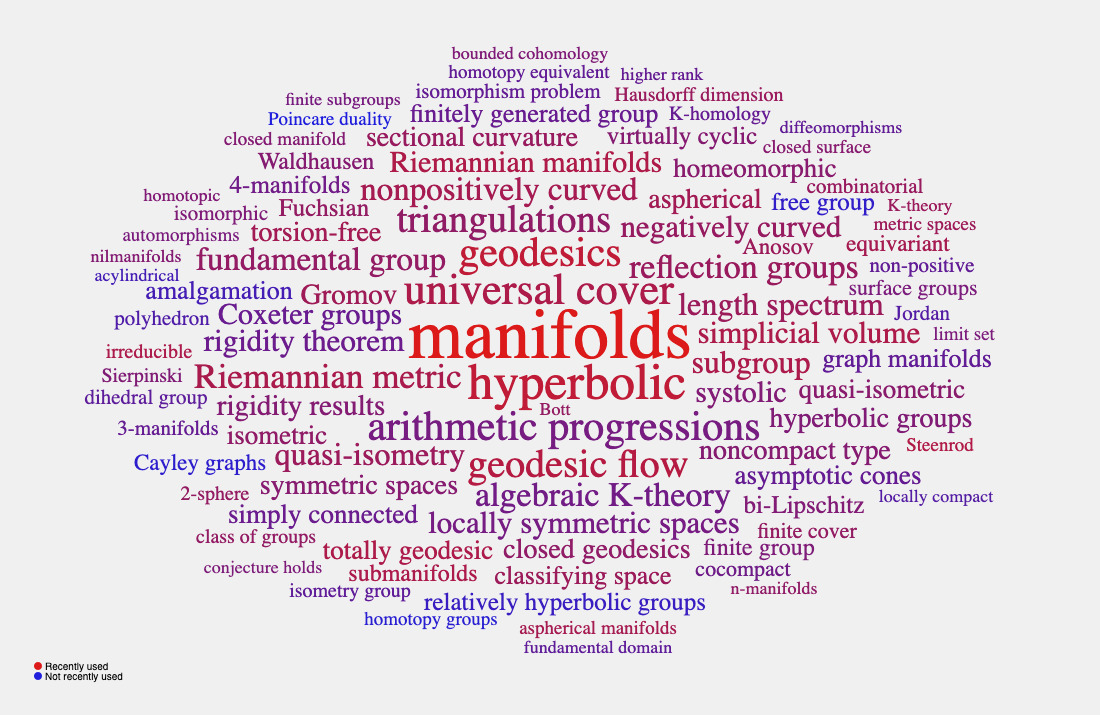
group theory, particularly in the presence of non-positive curvature. Here's a link to a pretty nifty Keyword cloud generated by Scimeter from
my papers on arXiv. The picture indicates frequent words appearing in my papers, and gives a pretty good idea of the various mathematics topics I like to think about.
Here are all of my completed projects (in reverse
chronological order). The work done here is partly supported by the National Science
Foundation under grants DMS-0606002 (2006-2009), DMS-0906483 (2009-2012), DMS-1207782 (2012-2015), DMS-1510640 (2015-2018),
DMS-1812028 (2018-2021), DMS-2109683 (2021-2024)
and by an Alfred P. Sloan Research Fellowship (2008-2012).
You can view/hide the individual papers abstracts by clicking on the appropriate link. Alternatively you can
Show all Abstracts |
Hide all Abstracts
If you find yourself enjoying this sort of math, you might be interested in having a look at the work of some of
my collaborators:
G. Arzhantseva,
M. Bucher,
C. Connell,
D. Constantine,
M. Davis,
F.T. Farrell,
D. Fisher,
J. Fowler,
S. Francaviglia,
R. Frigerio,
A. Gogolev,
D. Groves,
T. Januszkiewicz,
Kyle Joecken,
D. Juan-Pineda,
A. Kar,
R. Kowalick,
B. Magurn,
J. Manning,
D.B. McReynolds,
S. Millan-Vossler,
N. Miller,
A. Minasyan,
B. Minemyer,
C. Neofytidis.
I. Ortiz,
S. Pallekonda,
Ch. Pittet,
E. Prassidis,
A. Rahm,
R. Roy,
L. Ruffoni,
R. Sánchez-García,
L. J. Sánchez Saldaña,
B. Schmidt,
A. Sisto,
G. Sorcar,
M. Stover,
D. Thompson,
B. Tshishiku,
W. van Limbeek,
Kun Wang,
Shi Wang, and
Fangyang Zheng.
Submitted papers:
- Relative cubulation of relative strict hyperbolization
(joint with L. Ruffoni, with an appendix by D. Groves and J. Manning)
Abstract.
27 pages as a preprint.
We prove that many relatively hyperbolic groups obtained by relative strict hyperbolization admit a cocompact action on a CAT(0) cubical complex. Under suitable assumptions on the peripheral subgroups, these groups are residually finite and even virtually special. We include some applications to the theory of manifolds, such as the construction of new non-positively curved Riemannian manifolds with residually finite fundamental group, and the existence of non-triangulable aspherical manifolds with virtually special fundamental group.
Accepted papers:
- Special cubulation of strict hyperbolization
(joint with L. Ruffoni)
Abstract.
71 pages as a preprint. To appear in Invent. Math.
We prove that the Gromov hyperbolic groups obtained by the strict hyperbolization procedure of Charney and Davis are virtually compact special, hence linear and residually finite, if the initial complex satisfies some minor conditions. Our strategy consists in constructing an action of a hyperbolized group on a certain dual CAT(0) cubical complex. As a result, all the common applications of strict hyperbolization are shown to provide manifolds with virtually compact special fundamental group. In particular, we obtain examples of closed negatively curved Riemannian manifolds whose fundamental groups are linear and virtually algebraically fiber.
Published papers:
2021
- Finiteness of maximal geodesic submanifolds in hyperbolic hybrids
(joint with D. Fisher, N. Miller,
and M. Stover)
Abstract.
31 pages as a preprint. Final version in J. Eur. Math. Soc. (JEMS) 23 (2021), pgs. 3591-3623.
We show that large classes of non-arithmetic hyperbolic n-manifolds,
including the hybrids introduced by Gromov and Piatetski-Shapiro and many of
their generalizations, have only finitely many finite-volume immersed totally
geodesic hypersurfaces. In higher codimension, we prove finiteness for geodesic
submanifolds of dimension at least two that are maximal, i.e., not properly
contained in a proper geodesic submanifold of the ambient n-manifold. The
proof is a mix of structure theory for arithmetic groups, dynamics, and
geometry in negative curvature.
- Virtually cyclic dimension for 3-manifold groups
(joint with Kyle Joecken and L. J. Sánchez Saldaña)
Abstract.
21 pages as a preprint. Final version in Groups Geom. Dyn. 15 (2021), pgs. 577-606.
We explicitly compute the virtually cyclic geometric dimension for the fundamental group of any connected, closed,
orientable 3-manifold. Among the tools we use are the
prime and JSJ decompositions of M, several push-out type constructions, as well as some Bredon
cohomology computations.
2020
- The weak specification property for geodesic flows on CAT(-1) spaces
(joint with D. Constantine and D. Thompson)
Abstract.
30 pages as a preprint. Final version in Groups Geom. Dyn. 14 (2020), pgs. 297-336.
We prove that the geodesic flow on a compact locally CAT(-1) space has the weak specification property,
and give various applications of this property. We show that every Holder continuous function on the space
of geodesics has a unique equilibrium state, and as a result, that the Bowen-Margulis measure is the unique
measure of maximal entropy. We establish the equidistribution of weighted periodic orbits and the large
deviations principle for all such measures. For compact locally CAT(0) spaces, we give partial results, both
positive and negative, on the specification property and the existence of a coding of the geodesic flow by a
suspension flow over a compact shift of finite type.
- Strong symbolic dynamics for geodesic flow on CAT(-1) spaces and other metric Anosov flows
(joint with D. Constantine and D. Thompson)
Abstract.
25 pages as a preprint. Final version in J. Éc. Polytech. Math. 7 (2020), pgs. 201-231.
We prove that the geodesic flow on a compact, locally CAT(-1) metric space can be coded by a suspension flow over an irreducible shift of finite type with Hölder roof function. This is achieved by showing that the geodesic flow is a metric Anosov flow, and obtaining Hölder regularity of return times for a special class of geometrically constructed local cross-sections to the flow. We obtain a number of strong results on the dynamics of the flow with respect to equilibrium measures for Hölder potentials. In particular, we prove that the Bowen-Margulis measure is Bernoulli except for the exceptional case that all closed orbit periods are integer multiples of a common constant. We show that our techniques also extend to the geodesic flow associated to a projective Anosov representation, which verifies that the full power of symbolic dynamics is available in that setting.
2019
- Marked length rigidity for Fuchsian buildings
(joint with D. Constantine)
Abstract.
29 pages as a preprint. Final version in Ergodic Theory Dynam. Systems 39 (2019), pgs. 3262-3291.
We consider finite 2-complexes X that arise as quotients of Fuchsian buildings by subgroups of the combinatorial automorphism group, which we assume act freely and cocompactly. We show that locally CAT(-1) metrics on X which are piecewise hyperbolic, and satisfy a natural non-singularity condition at vertices are marked length spectrum rigid within certain classes of negatively curved, piecewise Riemannian metrics on X. As a key step in our proof, we show that the marked length spectrum function for such metrics determines the volume of X.
- Filling triangulated surfaces
(joint with R. Kowalick and B. Minemyer)
Abstract.
14 pages as a preprint. Final version in Geom. Dedicata 202 (2019), pgs.
373-386.
Given a triangulated closed oriented surface M, we provide upper bounds on the number of tetrahedra needed to construct a triangulated 3-manifold N which bounds M. Along the way, we develop a technique to translate (in all dimensions) between the famous Riemannian systolic inequalities of Gromov and combinatorial analogues of these inequalities.
- Marked length rigidity for one dimensional spaces
(joint with D. Constantine)
Abstract.
39 pages as a preprint. Final version in J. Topol. Anal. 11 (2019), pgs.
585-621.
We prove that for compact, non-contractible, one dimensional geodesic spaces, a version of the
marked length spectrum conjecture holds. For a compact
one dimensional geodesic space X, we define a subspace Conv(X). When X is non-contractible, we
show that X deformation retracts to Conv(X). If two such spaces
X, Y have the same marked length spectrum, we prove that Conv(X) and Conv(Y)
are isometric to each other.
- Fat flats in rank-one manifolds
(joint with D. Constantine, D.B. McReynolds, and D. Thompson)
Abstract.
23 pages as a preprint. Final version in Michigan Math. J. 68 (2019), pgs.
251-275.
We study closed non-positively curved Riemannian manifolds M which admit fat k-flats: that is, the universal cover \(\tilde M\) contains a positive radius neighborhood of
a k-flat on which the sectional curvatures are identically zero. We investigate how the fat k-flats affect the cardinality of the collection of closed geodesics. Our first main
result is to construct rank-one non-positively curved manifolds where the fat flat corresponds to a twisted cylindrical neighborbood of a geodesic on M. As a result, M
contains an embedded periodic geodesic with a flat neighborhood, but M nevertheless has only countably many closed geodesics. Such metrics can be constructed on
finite covers of arbitrary odd-dimensional finite volume hyperbolic manifolds. Our second main result is to prove a closing theorem for fat flats, which implies that a
manifold M with a fat k-flat contains an immersed, totally geodesic k-dimensional flat closed submanifold. This guarantees the existence of uncountably many closed
geodesics when \(k \geq 2\). Finally, we collect results on thermodynamic formalism for the class of manifolds considered in this paper.
- Hyperbolic groups with boundary an n-dimensional Sierpinski space
(joint with B. Tshishiku)
Abstract.
13 pages as a preprint. Final version in J. Topol. Anal. 11 (2019), pgs.
233-247.
For \(n\geq 7\), we show that if \(G\) is a torsion-free hyperbolic group whose visual boundary is an \((n-2)\)-dimensional Sierpinski space, then
\(G=\pi_1(W)\) for some aspherical \(n\)-manifold W with nonempty boundary. Concerning the converse, we construct, for each \(n\geq 4\),
examples of locally CAT(-1) manifolds with non-empty totally geodesic boundary, but with visual boundary not homeomorphic to
an \((n-2)\)-dimensional Sierpinski space.
- Steenrod problem and the domination relation
(joint with C. Neofytidis)
Abstract.
9 pages as a preprint. Final version in Topology Appl. 255 (2019), pgs.
32-40.
We indicate how to combine some classical topology (Thom's work on the Steenrod problem) with some modern topology (simplicial volume) to show that every map between certain manifolds must have degree zero. We furthermore discuss a homotopy theoretic interpretation of parts of our proof, using Thom spaces and Steenrod powers.
- Barycentric straightening and bounded cohomology
(joint with S. Wang)
Abstract.
22 pages as a preprint. Final version in J. Eur. Math. Soc. (JEMS) 21 (2019), pgs.
381-403.
We study the barycentric straightening of simplices in higher rank irreducible symmetric spaces of non-compact type. We show that, for an
\(n\)-dimensional symmetric space of rank \(r \geq 2\) (excluding \(SL(3, \mathbb R)/ SO(3)\) and \(SL(4, \mathbb R)/SO(4)\)), the
\(p\)-Jacobian has uniformly bounded norm, provided \(p \geq n-r+2\). As a consequence, for the corresponding non-compact, connected,
semisimple real Lie group \(G\), in degrees \(p \geq n-r+2\), every degree \(p\) cohomology class has a bounded representative. This
answers Dupont’s problem in small codimension. We also give examples of symmetric spaces where the barycentrically straightened
simplices of dimension \(n-r\) have unbounded volume, showing that the range in which we obtain boundedness of the \(p\)-Jacobian is
very close to optimal.
- Primitive geodesic lengths and (almost) arithmetic progressions
(joint with D.B. McReynolds)
Abstract.
29 pages as a preprint. Final version in Publ. Mat. 63 (2019), pgs.
183-218.
We investigate when the set of primitive geodesic lengths on a Riemannian manifold have arbitrarily long
arithmetic progressions. We prove that in the space of negatively curved metrics, a metric having such arithmetic
progressions is quite rare. We introduce almost arithmetic progressions, a coarsification of arithmetic progressions,
and prove that every negatively curved, closed Riemannian manifold has arbitrarily long almost arithmetic
progressions in its primitive length spectrum. We also prove that every noncompact arithmetic hyperbolic 2- or
3-manifold has arbitrarily long arithmetic progressions in its primitive length spectrum. We end with a conjectural
characterization of arithmeticity.
2018
- Some Kähler structures on products of 2-spheres
(joint with G. Sorcar and F. Zheng)
Abstract.
14 pages as a preprint. Final version in Enseign. Math. 64 (2018), pgs.
127-142.
We consider a family of Kähler structures on products of 2-spheres, arising from complex Bott manifolds. These are obtained via iterated \(\mathbb P^1\)-bundle constructions, generalizing the classical Hirzebruch surfaces. We show that the resulting Kähler structures all have identical Chern classes. We construct Bott diagrams, which are rooted forests with an edge labelling by positive integers, and show that these classify these Kähler structures up to biholomorphism.
- Vanishing simplicial volume for certain affine manifolds
(joint with M. Bucher and C. Connell)
Abstract.
8 pages as a preprint. Final version in Proc. Amer. Math. Soc. 146 (2018), pgs.
1287-1294.
We show that closed aspherical manifolds supporting an affine structure, whose holonomy map is injective and contains a pure translation, must have vanishing
simplicial volume. This provides some further evidence for the veracity of the Auslander Conjecture. Along the way, we provide a simple cohomological criterion
for aspherical manifolds with normal amenable subgroups of \(\pi_1\) to have vanishing simplicial volume. This answers a special case of a question due to Lück.
2017
- Quasicircle boundaries and exotic almost-isometries
(joint with B. Schmidt and
W. van Limbeek)
Abstract.
16 pages as a preprint. Final version in Ann. Inst. Fourier 67 (2017), pgs.
863-877.
We consider properly discontinuous, isometric, convex co-compact actions of surface groups \(\Gamma\)
on a CAT(-1) space \(X\). We show that the limit set of such an action, equipped with the canonical visual
metric, is a (weak) quasicircle in the sense of Falconer and Marsh. It follows that the visual metrics on such
limit sets are classified, up to bi-Lipschitz equivalence, by their Hausdorff dimension. This result applies in
particular to boundaries at infinity of the universal cover of a locally CAT(-1) surface. We show that any two
periodic CAT(-1) metrics on \(\mathbb H^2\) can be scaled so as to be almost-isometric (though in general,
no equivariant almost-isometry exists). We also construct, on each higher genus surface, \(k\)-dimensional
families of equal area Riemannian metrics, with the property that their lifts to the universal covers are pairwise
almost-isometric but are not isometric to each other. Finally, we exhibit a gap phenomena for the optimal
multiplicative constant for a quasi-isometry between periodic CAT(-1) metrics on \(\mathbb H^2\).
2016
- On the Hausdorff dimension of CAT(k) surfaces
(joint with D. Constantine)
Abstract.
13 pages as a preprint. Final version in Anal. Geom. Metr. Spaces 4 (2016), pgs.
266-277.
We prove a that a closed surface with a CAT(k) metric has Hausdorff dimension = 2, and that
there are uniform upper and lower bounds on the two-dimensional Hausdorff measure of small
metric balls. We also discuss a connection between this uniformity condition and some results
on the dynamics of the geodesic flow for such surfaces. Finally, we give a short proof of topological
entropy rigidity for geodesic flow on certain CAT(-1) manifolds.
- Rigidity of almost-isometric universal covers
(joint with A. Kar and
B. Schmidt)
Abstract.
24 pages as a preprint.
Final version in Indiana Univ. Math. J. 65 (2016), pgs.
585-613.
Almost-isometries are quasi-isometries with multiplicative constant one. Lifting a pair of metrics on a
compact space gives quasi-isometric metrics on the universal cover. Under some additional hypotheses
on the metrics, we show that there is no almost-isometry between the universal covers. We show that
Riemannian manifolds which are almost-isometric have the same volume growth entropy. We establish
various rigidity results as applications.
- Revisiting Farrell's nonfiniteness of Nil
(joint with E. Prassidis and
K. Wang)
Abstract.
17 pages as a preprint. Final version in Ann. K-theory 1 (2016), pgs. 209-225.
We study Farrell Nil-groups associated to a finite order automorphism of a ring R. We show that any such Farrell Nil-group is either trivial, or infinitely generated (as an abelian group). Building on this first result, we then show that any finite group that occurs in such a Farrell Nil-group occurs with infinite multiplicity. If the original finite group is a direct summand, then the countably infinite sum of the finite subgroup also appears as a direct summand. We use this to deduce a structure theorem for countable Farrell Nil-groups with finite exponent. Finally, as an application, we show that if V is any virtually cyclic group, then the associated Farrell or Waldhausen Nil-groups can always be expressed as a countably infinite sum of copies of a finite group, provided they have finite exponent (which is always the case in dimension 0).
2015
2014
- Isomorphism versus commensurability for a class of finitely presented groups
(joint with G. Arzhantseva and
A. Minasyan)
Abstract.
13 pages as a preprint
Final version in J. Group Theory 17 (2014), pgs. 361-378.
We construct a class of finitely presented groups where the isomorphism problem is solvable but the
commensurability problem is unsolvable. Conversely, we construct a class of finitely presented groups
within which the commensurability problem is solvable but the isomorphism problem is unsolvable.
These are the first examples of such a contrastive complexity behavior with respect to the isomorphism
problem.
- Aspherical manifolds that cannot be triangulated
(joint with M. Davis and
J. Fowler)
Abstract.
10 pages as a preprint.
Final version in Algebr. Geom. Topol. 14 (2014), pgs. 795-803.
We apply hyperbolization techniques to construct, in each dimension >5, closed aspherical
manifolds that cannot be triangulated. This complements
a construction of 4-dimensional examples by Davis-Januszkiewicz. The question remains
open in dimension =5.
2012
- Rational equivariant K-homology of low dimensional groups
(joint with I. Ortiz and
R. Sánchez-García)
Abstract.
33 pages as a preprint.
Final version in Clay Math. Proceedings 16 (2012), pgs. 131-164.
The volume is entitled
Topics in Noncommutative Geometry, Proceedings of the
3rd Winter School at the
Luis Santaló-CIMPA Research School (Buenos Aires, 2010).
We consider groups G which have a cocompact 3-manifold model
for the classifying space for proper G-actions. We provide an algorithm for computing the
rationalized equivariant K-homology of the classifying space. Under the additional hypothesis
that the G-action on the 3-dimensional model is smooth, the Baum-Connes conjecture holds,
and the rationalized K-homology groups
of the classifying space coincide with the rationalized topological K-theory of the
reduced C*-algebra of G. We illustrate our algorithm on several concrete examples.
- Comparing semi-norms on homology
(joint with Ch. Pittet)
Abstract.
13 pages as a preprint.
Final version in Pacific J. Math. 259 (2012), pgs. 373-385.
We compare the l1-seminorm and the manifold seminorm on integral homology classes.
The l1-seminorm
is always bounded above by the manifold seminorm.
We explain how it easily follows from work of Crowley & Löh that in degrees distinct from three,
these two seminorms in fact coincide. We compute the simplicial volume of the 3-dimensional
Tomei manifold and apply
Gaĭfullin's desingularization to establish the existence of a constant (approximately equal to
0.0115416), with the property that for any degree three homology class, the l1-seminorm
is bounded below by the constant times the manifold seminorm.
- 4-dimensional locally CAT(0)-manifolds with no Riemannian smoothings
(joint with M. Davis and
T. Januszkiewicz)
Abstract.
20 pages as a preprint.
Final version in Duke Math. Journal 161 (2012), pgs. 1-28.
We construct examples of 4-dimensional manifolds M supporting a locally
CAT(0)-metric, whose universal cover X satisfy Hruska's isolated flats condition, and
contain 2-dimensional flats F with the property that the boundary at infinity of F defines a
nontrivial knot in the boundary at infinity of X. As a consequence, we
obtain that the fundamental group of M cannot be isomorphic to the fundamental
group of any closed Riemannian manifold of nonpositive sectional curvature. In particular, M
is a locally CAT(0)-manifold which does not support any Riemannian metric of nonpositive
sectional curvature.
2011
- Algebraic K-theory of virtually free groups
(joint with D. Juan-Pineda,
S. Millan-Vossler, and S. Pallekonda)
Abstract.
22 pages as a preprint. Final version in Proc. Roy. Soc. Edinburgh Sect. A
141 (2011), pgs. 1295-1316.
We provide a general procedure for computing the algebraic K-theory of finitely generated virtually free groups.
The procedure describes these groups in terms of (1) the algebraic K-theory of various finite subgroups, and
(2) various Farrell Nil-groups. We illustrate the process by carrying out the computation for several interesting
classes of examples. The first two classes serve as a check on the method, and show that our algorithm recovers
results already existing in the literature. The last two classes of examples yield new computations.
2010
- Large scale detection of half-flats in CAT(0)-spaces
(joint with S. Francaviglia)
Abstract.
21 pages as a preprint.
Final version in Indiana Univ. Math. J. 59 (2010), pgs.
395-415.
For a k-flat F inside a locally compact CAT(0)-space X, we identify various conditions that ensure that
F bounds a (k+1)-dimensional half flat in X. Our conditions are formulated in terms of the ultralimit of X.
As applications, we obtain (1) constraints on the behavior of quasi-isometries between tocally compact
CAT(0)-spaces, (2) constraints on the possible non-positively curved Riemannian metrics supported by
certain manifolds, and (3) a correspondence between metric splittings of a complete, simply connected,
non-positively curved Riemannian manifold and the metric splittings of its asymptotic cones. Furthermore,
combining our results with the Ballmann, Burns-Spatzier rigidity theorem and the classical Mostow rigidity
theorem, we also obtain (4) a new proof of Gromov's rigidity theorem for higher rank locally symmetric spaces.
- Lower algebraic K-theory of certain reflection groups
(joint with B. Magurn
and I. Ortiz).
Abstract.
35 pages as a preprint.
Final version in Math. Proc. Cambridge Philos. Soc. 148 (2010), pgs.
193-226.
A 3-dimensional hyperbolic reflection group is a Coxeter group arising as a lattice in the isometry
group of hyperbolic 3-space, with fundamental domain a finite volume geodesic polyhedron P.
Building on our previous work (the case where P was a tetrahedron), we provide formulas for the lower
algebraic K-theory of the integral group ring of all the 3-dimensional hyperbolic reflection groups, in
terms of the combinatorics of the polyhedron P. As part of the computation, we provide number
theoretic formulas for some of the lower algebraic K-groups of dihedral groups, as well as products
of dihedral groups with the cyclic group of order two.
2009
- A boundary version of Cartan-Hadamard and applications to rigidity
Abstract.
30 pages as a preprint.
Final version in J. Topol. Anal. 1 (2009), pgs. 431-459.
We show that in dimensions distinct from five, any two compact, negatively curved Riemannian
manifolds with non-empty, totally geodesic boundary, have universal covers with
homeomorphic boundaries at
infinity. We show that in any given dimension, the diffeomorphism type of the universal cover of
a compact, non-positively curved Riemannian manifolds with totally geodesic boundary is
completely determined by the number of boundary components of the universal cover.
We also show that the number of boundary components is either 0, 2, or infinity.
As an application, we show that simple, thick, negatively curved P-manifolds of
dimension greater than five are topologically rigid. We discuss various corollaries of
topological rigidity (diagram rigidity, weak co-Hopf property, Nielson realization problem).
- A note on strong Jordan separation
Abstract.
8 pages as a preprint.
Final version in Publ. Mat. 53 (2009), pgs. 515-525.
We provide a strengthening of Jordan separation, to the setting of maps from a compact topological
space X into a sphere, where
the source space X is not necessarily a codimension one sphere, and the map is not necessarily injective.
- Involutions of negatively curved groups with wild boundary
behavior (joint with F.T. Farrell)
Abstract.
19 pages as a preprint. Final version in the
Hirzebruch
special issue of Pure Appl. Math. Q. 5 (2009),
pgs. 619-640.
For a totally geodesic subspace Y of a compact locally CAT(-1)
space X, one has an embedding of the boundary at infinity of the universal cover of Y
into the boundary at infinity of the universal cover of X. In the case where the
boundaries at infinity are spheres whose dimensions differ by two, we show that if the
embedding is tame, it is unknotted. We give examples of pairs (X,Y) where the embedding
is indeed knotted. In our examples, the embedded codimension two sphere is the fixed
point set of a naturally defined involution of the ambient sphere. In passing, we also
give an algebraic criterion for knottedness of tame codimension two spheres in high
dimensional (>5) spheres.
2008
2007
- Relative hyperbolicity, classifying spaces, and lower algebraic K-theory
(joint with I. Ortiz)
Abstract.
28 pages as a preprint.
Final version in Topology 46 (2007), pgs. 527-553.
For G a relatively hyperbolic group, we provide a recipe for constructing a model for the
universal space among G-spaces with isotropy in the family of virtually cyclic subgroups of G.
For G a Coxeter group acting as a non-uniform lattice on hyperbolic 3-space, we construct
the classifying space explicitly, resulting in an 8-dimensional classifying space. We use
the classifying space we obtain to compute the lower algebraic K-theory for one of these
Coxeter groups.
- Rigidity of hyperbolic P-manifolds: a survey
Abstract.
11 pages as a preprint.
Final version in Geom. Dedicata 124 (2007), pgs. 143-152.
In this survey paper, we outline the proofs of the rigidity theorems for simple, thick,
hyperbolic P-manifolds found in three of our earlier papers ("Diagram rigidity", "Strong
Jordan separation" and "Rigidity results").
- Diagram rigidity for geometric amalgamations of free groups
Abstract.
16 pages as a preprint.
Final version in J. Pure Appl. Algebra 209 (2007), pgs.
771-780.
We prove a topological rigidity result for simple, thick, hyperbolic P-manifolds of dimension 2:
isomorphism of the fundamental groups implies homeomorphism of the P-manifolds. An immediate
application is a diagram rigidity theorem for certain amalgamations of free groups: the direct
limits of two such diagrams are isomorphic if and only if there is an isomorphism between the
respective diagrams.
- A note on characteristic numbers of non-positively curved manifolds
(joint with R. Roy)
Abstract.
11 pages as a preprint.
Final version in Expo. Math. 25 (2007), pgs. 21-35.
In this expository paper, we provide vanishing/non-vanishing results for characteristic
numbers of non-positively curved Riemannian manifolds. In the locally symmetric case we
give a very simple proof of the Hirzebruch proportionality principle for Pontrjagin numbers.
We also exhibit vanishing of some characteristic numbers for the
Gromov-Thurston examples of negatively curved manifolds. A byproduct of our argument is
a simple constructive proof of Rohlin's Theorem: that every compact orientable 3-manifold
bounds orientably. Various topological consequences
are discussed, and some new applications are given.
2006
- On submanifolds in locally symmetric spaces of non-compact type
(joint with B. Schmidt)
Abstract.
16 pages as a preprint.
Final version in Algebr. Geom. Topol.
6 (2006), pgs. 2455-2472.
Given a connected, totally geodesic submanifold Y inside a compact locally symmetric space
of non-compact type X, we provide a condition that ensures that Y is homologically non-trivial
in X. In low dimensions (relative to the dimension of X), our sufficient condition is also necessary.
We provide conditions under which there exist a tangential map of pairs from a finite cover of the pair
(X,Y) to the non-negatively curved dual pair of spaces.
- Simplicial volume of closed locally symmetric spaces of non-compact type
(joint with B. Schmidt)
Abstract.
15 pages as a preprint.
Final version in Acta Math. 197 (2006), pgs. 129-143.
We show that compact, locally symmetric spaces of non-compact type have positive simplicial
volume. This gives a positive answer to a question that was first raised by Gromov in 1982.
We provide a summary of results that are known to follow from positivity of the simplicial
volume.
- Roundness properties of groups (joint with E. Prassidis)
Abstract.
22 pages as a preprint.
Final version
in Geom. Dedicata 117 (2006), pgs. 137-160.
We study topological/geometric consequences of roundness and generalized roundness (metric
invariants introduced
by P. Enflo with substantial applications in functional analysis). We show that any compact
Riemannian manifold with non-trivial fundamental group has
roundness =1. We show that proper geodesic spaces with roundness =2 are contractible.
For a finitely generated group G, we
define the roundness spectrum R[G], a subset of the positive reals. We
show that R[G] always contains 1, and if G is infinite then R[G] is contained in the
interval [1,2]. We show that, if G is a free group, then R[G]
contains 2. We show that for the free abelian group on >1 generators, R[G]={1}. We prove
that if a group G has the property that 1 is not in R[G], then G is a torsion group with every
element of order 2, 3, 5, or 7. We point out
that if a group has a presentation whose Cayley graph has generalized roundness >0, then it
satisfies the coarse Baum-Connes conjecture (and hence, the strong Novikov conjecture). We show
that for Kazhdan groups, every Cayley graph has generalized roundness =0.
2005
- EZ-structures and topological applications (joint with F.T. Farrell)
Abstract.
19 pages as a preprint.
Final version
in Comment. Math. Helv. 80 (2005), pgs. 103-121.
We extend Bestvina's notion of a Z-structure to that of
an EZ-structure, and extend Farrell-Hsiang's condition (*) to condition
(**). Examples of groups having an EZ-structure include delta hyperbolic
groups and CAT(0) groups. Our first theorem shows that groups having an
EZ-structure automatically satisfy condition (**). Our second theorem
shows that condition (**) implies a version of the Novikov conjecture.
Our third
theorem restricts to the case of delta hyperbolic groups G, and provides a lower
bound for the homotopy groups of the spaces obtained by applying the stable
topological pseudo-isotopy functor to the classifying space of G.
2004
- Rigidity results for certain 3-dimensional singular spaces
and their fundamental groups
Abstract.
23 pages as a preprint.
Final version
in Geom. Dedicata 109 (2004), pgs. 197-219.
We introduce hyperbolic P-manifolds, which are certain
non-positively curved metric spaces having a stratification by compact
hyperbolic manifolds with totally geodesic boundary. For simple, thick,
3-dimensional hyperbolic P-manifolds, we give a topological criterion to
recognize boundary points corresponding to lower dimensional strata. As
a consequence of this main result, we obtain a version of Mostow rigidity
for these spaces, as well as quasi-isometric rigidity for their
fundamental groups.
- Finite automorphisms of negatively curved Poincare Duality
groups (joint with F.T. Farrell)
Abstract.
11 pages as a preprint.
Final version in
Geom. Funct. Anal. 14 (2004), pgs. 283-294.
We show that, for a finite p-group acting on a negatively
curved Poincare Duality group over Z, the fixed subgroup is a Poincare
Duality group over Z/p. We provide examples to show that the fixed
subgroup might not even be a duality group over Z.
Papers being revised:
These papers are complete, but are currently being revised in order to improve the
results they contain. Be aware that the results in these papers, while correct,
are definitely not optimal. I also include [in brackets] the improvements
I believe can be done on the existing results (and which are currently being worked on).
Papers not intended for publication:
Work in progress:
The following projects are in various stages of typing. Preprints will be available
as soon as they get completed. The descriptions below reflect, to the best of my knowledge,
the results that will be appearing in the completed papers. Where possible, I state [in brackets]
the work that still remains to be done on the various projects. The projects are organized
roughly according to proximity to completion (closest to finished are at the top of the list).
- Kleinian groups: lattice retracts, accessibility, and the Farrell-Jones isomorphism
conjectures
(joint with I. Ortiz, and D. Vavrichek).
Summary.
Using some of the spectacular recent work in 3-manifold theory, we show that various isomorphism conjectures known to hold for lattices in the isometry group of hyperbolic 3-space actually hold for the broader class of Kleinian groups. In previous work, I'd developed techniques with Ortiz for computing the lower algebraic K-theory of lattices inside the isometry group of hyperbolic 3-space; we also show that these techniques can now be extended to the setting of Kleinian groups.
[This paper still needs some work. We can currently deal with the case of Kleinian groups that are 1-ended and do not split over any 2-ended subgroup. We are working on removing the "does not split over 2-ended subgroup" hypothesis.]